
 Last week I saw a commercial for the new Cadillac XTS that featured an innovative touch technology called the Safety Alert Seat. The system sends vibrating pulses to drivers through the seat cushion if they drift out of their lane without a turn signal activated or if there is threat from the front or rear, such as when backing blind out of a parking space.
“It’s akin to someone tapping on your shoulder in a crowd to get your attention,” said, General Motors Active Safety Technical Fellow Raymond Kiefer. “Using the tactile sense to communicate crash threat direction provides an effective and intuitive way to cut through the clutter of visual and auditory sensory information that drivers routinely experience.”
Cool!
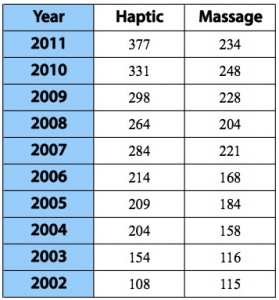
Number of annual peer-reviewed research papers.
Source: EBSCOhost
This technology had been developed in a field of touch research that I have been following for the past 15 years called “haptics,” derived from the Greek word meaning “pertaining to the sense of touch.” Thus, if you are studying touch, you are studying haptics.
Since the only thing that all 100+ modalities of massage and bodywork have in common is that they are all based on touch, it would seem only natural that the massage industry would have a close association with the folks doing haptic research. Unfortunately, that is not the case. Even the recently published groundbreaking textbook on massage therapy research (Massage Therapy: Integrating Research and Practice) makes no mention of haptic research.
As noted in the accompanying chart, annual research in massage has actually leveled off in the past five years while annual haptic research surpassed massage research ten years ago and continues to grow steadily each year.
Who is doing haptics research?
There are scores of companies developing products based on haptics research. Many do their own research and others partner with academic institutions such as:
- Massachusetts Institute of Technology: MIT TouchLab
- Johns Hopkins University: Haptics Laboratory
- Purdue University: Haptic Interface Research Laboratory
- University of Pennsylvania: Grasp Lab Haptics Group
- University of Southern California: Haptics and Virtual Environments Lab
- Stanford University: Virtual Human Interaction Lab
Disney Research is an example of a major corporation investing in touch research: Surround Haptics – Immersive Tactile Experiences
Why are they doing haptic research?
Most research in haptics has focused on extending the human ability to reach, explore, grasp, manipulate and get feedback from the world around us. Applications can be found in robotics, prosthetics, remote medicine and surgery, hazardous environments, manufacturing, communications and education.
Closer to home, the phone vibrating in your pocket and the joystick on your gaming console are both a result of haptics research.
In the future, haptics will become an essential aspect of virtual human interaction in such arenas as business meetings and classrooms. Sound waves are being studied for their ability to mimic touch making virtual handshakes within the realm of possibility.
How is this important to massage?
Since massage and haptics have never interfaced with one another, at first glance, they may not appear to have much in common. But that is definitely not the case. Here are some reasons why we should be working together.
Defining touch
One of the outcomes of haptics research has been to define the discreet constituents of touch mechanics (movement, friction control, vibration, contact force, pressure, duration) and to develop models for discriminating texture, softness, ridgidity, temperature, moisture, shape, proprioception/orientation and weight/heft.
All of these components are critical to massage and thus essential to informed massage education, practice, evolution and research.
Standardizing touch
A serious flaw in virtually all massage research to date is the lack of standardized protocols. “Subjects received ten-minutes of massage to the lower back,” is not a particularly useful sentence in a massage research paper because it is difficult, if not impossible, to duplicate.
We need to define a common vocabulary of touch far beyond effluerage, petrissage and tapotement. Iris Burman and Sandy Friedland made an attempt in their book TouchAbilities: Essential Connections, but far more refinement is required.
One of the reasons that I feel fortunate that my massage modality is Japanese acupressure is because there is a built in precision to the acupressure points, the channels they lie upon and the techniques that are used to stimulate them. I am a big fan of quality control in massage, so I also teach chair massage as one would a martial art, that is through “Katas,” highly choreographed sequences of techniques, point locations and body mechanics. The kata model is one of the few in massage that allows for high standardization of protocols.
Touch tools
As haptics has defined the parameters and functions of touch, out of necessity the field has also had to develop tools that apply and measure each aspect of touch. These tools can obviously be used by massage researchers to apply standardized touch, measure touch or used as controls in touch research.
The biology of touch
Haptics is as interested in the anatomy and neurophysiology of touch as is massage and they have the money to pay for functional MRIs. We need to be monitoring their work, sharing information and cross-fertilizing our fields.
The psychology of touch
Research into how haptic aspects affect the psychology of gaming (the thrill of driving on that racetrack), computer shopping (where you can feel the texture of the skirt you are viewing on your monitor), and mutual virtual touching continues to expand. Investigating the psychology of touch is in its infancy and the massage industry needs to be accessing research and resources wherever we can.
Massage is poor; commerce is rich
The massage industry has suffered from an inferiority complex (fighting a negative public perception) and consequent lack of imagination for decades. Because of our fear of embracing touch (see related article), we have allowed commercial interests outside of the profession to charge ahead with a touch research agenda that is almost totally off the radar of the massage industry.
The massage industry should be in the middle of all touch research, not standing on the sidelines. It is time to take off the blinders and begin dialoging and collaborating with the commercial and academic interests who are spending millions of dollars researching touch.
Let’s get in the driver’s seat, folks!
I liked the article and will look for haptic research results; thanks for the links.
Thank you David! This has interesting implications in some areas, but I think the two fields only meet at the borders. I am all about quantifying touch, if that helps define good therapeutic treatment. But massage is also part art, because not every person on every day needs exactly the same protocol.
I agree with your “kata” model to some degree, especially as a teaching tool or a standard option. It would be good for research as well, where standardization is one key to accurate results. Haptic measurement tools would come into play here as well, if such were available, and the essence of our best therapeutic moves could be clearly defined.
My first massage teacher did all of his Swedish sessions in the same way, seldom deviating from the thorough but measured coverage of each body part. He had some good reasons for doing this, which I understand. I do a more targeted problem-solving treatment model, and I have good reasons as well. I use an “arsenal” of possible techniques, but they are dependent upon the judgment of the therapist and the requests and unstated needs of the client at that particular time. Massage will always be part science and part art; it is possible to define and standardize, but it may only be wise to do so to a certain point.
I disagree that massage has an “inferiority complex” just because it is “poor.” Commerce is rich because it lacks ethics, and is fueled by greed, and the empty charm of glittering consumer goods. Massage therapists care about service, and are poor because many care less than they should about money. Most of us care very much about ethics in a way that commerce never will.
Can haptics do more than make a device that will get your attention? Can it relax you as well? (Think of the Microsoft Sound, composed by Brian Eno, which does both.) I wonder if someone will try to make a robot that can massage people. It may have better moves, but it will never have human empathy, interactivity, and judgment.
I suspect that haptics will be used for evil more than good–getting people to work harder, buy more stuff, react rather than act, and respond more from the sympathetic rather than parasympathetic nervous system. The people of the future are going to need lots of massage therapy.
One thing the therapeutic massage profession does need is scientific rigor. In this regard we are even behind psychology, which is at best considered a “soft” science by fellow scientists. As in clinical psychology, many widely accepted treatments lack a proven mechanism, and have not been shown to effectively treat conditions. I think the future of massage is in demonstrating effectiveness in a majority of people, or switching to techniques that do so. Can haptics help us to do this?
Nice post!