
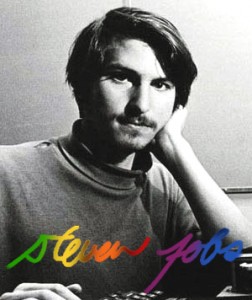
 The first time we nervously walked into Apple Computer’s Macintosh division in 1984 to provide seated massage with our matching grey slacks, white polo shirts and blue blazers, we felt overdressed. At a time when the largest computer company in the world, IBM, was still requiring dark suits, white shirts and ties on all of its workers, while Apple employees were all about jeans and T-shirts. We immediately breathed a sigh of relief and settled in for a year that would change the massage industry forever.
Apple Computer was already a high-flying, high-tech legend helmed by 29 year old Steve Jobs who was revolutionizing the nascent personal computer industry. But equally significant, Jobs was also redefining the relationship between a company and its employees. With the casual dress code and the pirate flag that flew over the Macintosh building, Jobs was heralding and prototyping the shift away from the 20th Century paternalistic, conformist corporate culture that treated employees as replaceable parts working for a paycheck.
Instead, he was inventing a 21st Century ethic based on the belief that fundamentally work should be an outlet for creativity and that the most productive workers are those who are challenged to perform to their highest potential and whose work makes a difference in the world. At Apple, employees were judged not by their resume, education, clothes or experience but by their intelligence, passion, creativity and performance.
Jobs nurtured an employee-centric environment. He rejected the idea of a personnel department and instituted a human resources staff charged with creating a workplace that was inviting, exciting and supportive. Apple employees were expected to work 60 hours a week or more, but Jobs wanted them well taken care of.
One of the departments working long hours was in charge of writing the user manuals for the new hardware and software products and, at that particular moment, they were under deadline. The head of the department, Chris Espinosa, was trying to figure out how to spend his monthly budget allocated for employee amenities. They already had the beer busts on Fridays and the occasional private, first-run movie screening, but he was looking for something special. By chance, a friend handed him a flyer advertising a service that would bring massage right into the employee cubicles. Definitely a crazy idea, but that was exactly the kind innovative service that fit the Apple culture.
When I got the call from Chris, I was ecstatic. Up to that point seated massage was an experiment. We tried every way we could think of to market this new approach to professional massage. I knew we needed a high profile company to put its imprimatur on our work before we would ever be taken seriously. Apple was a perfect match for chair massage and ultimately turned out to be our ticket to success. But not in quite the way I had imagined.
After our first visit to Chris’s department, we were invited back the following week. That’s when the folks in accounting, a few cubicles over, said they would like to get in on some of that massage action. Each week we kept adding more departments and doing more massages.
At the peak of our work with Apple, seven practitioners were offering up to 350 chair massages a week with the company footing the entire bill. I had visions of megabucks dancing in my head. I thought that our little service would turn into a tsunami that would soon sweep across corporate America. I was wrong.
The honeymoon at Apple ended in 1985 when the first downturn hit the personal computer industry and Apple was forced to lay off 800 employees. The company could no longer justify paying for first class airline tickets, fresh orange juice, or massage. We withdrew our services from Apple for two months, until the dust of reorganization settled. When we returned, it was the employees who were now paying for seated massage. Our client base plummeted to about 60 massages a week.
There was going to be no tidal wave, at least not in the corporate world. What actually had occurred was that a company ahead of its time, Apple, found a service, seated massage, that was also ahead of its time. The bulk of the business world ignored us. Massages at work? Who were we kidding?
However, by taking a chance on chair massage Steve Jobs did revolutionize the massage industry. He helped us prove that, given the right conditions, chair massage was a viable service for the workplace. We were also able to leverage our experience at Apple into dozens of national and local stories in the press, television, and radio. It turned out that the media loved chair massage. It was an ideal “Cinderella” story. Out of the ashes of disrepute (read: massage parlors) and into the corporate boardroom came chair massage.
That publicity, in turn, laid the foundation for my revised long-range plan to bring professional touch to the masses. In 1986, I sold my portion of the business to a partner and began the task of creating a chair massage profession by training chair massage professionals. In May of that year, when the first massage chair came to market to coincide with the creation of the first training organization, On-Site Enterprises (now TouchPro) to teach table massage practitioners how to perform and market chair massage.
Then, finally, the tsunami did in fact hit. When I showed off the massage chair to 34 school directors at a meeting of the American Massage Therapy Association that August, the response was immediate and overwhelming. During the next 12-months, I taught 20 chair massage seminars at schools throughout the United States, Canada, Sweden, and Norway.
For the massage profession chair massage was truly an idea whose time had come. Within four years, by 1990, virtually every massage school in the United States was teaching their students about chair massage.
The revolution Steve Jobs inspired was not just a technological one, but a cultural one as well. It extended far beyond computers, phones, and media distribution systems and deep into our perception of work and the work environment. While a chair massage industry was probably inevitable, the innovative laboratory that was Apple Computer provided chair massage with the credibility it needed to move forward at a critical moment.
Today, thousands of companies around the world embrace chair massage as an essential part of the workplace and tens of thousands of practitioners make their living providing affordable chair massage services to hundreds of thousands of customers each year. Thanks, Steve. You changed the world in more ways than you will ever know.
Question: Do you have any stories to share about pre-1986 seated massage?
David, Thanks for publishing this. I’ve heard you talk about some of this before but now we have “the rest of the story.” I just finished reading “Steve Jobs” biography and was hoping this would be included in the book.
Much was made of the massages at Apple in many of the first round of books that traced the history of the Macintosh computer. Guy Kawasaki’s 1990 history, The Way of Macintosh, is one good example. The fact that little note is paid now to massages in the workplace I attribute to the commonplace status that the service has achieved. Over time I will be scanning and posting early articles about chair massage for the history buffs and massage students with papers to write.
Thank you for this history. I didn’t know this. You and Steve Jobs have a lot in common: both before your time, changing the face of our everyday life for the better and definitely changing the face of your industries. It’s a shame this wasn’t reviewed in his biography.
Hi David, Delighted to read your article on Steve Jobs and chair massage at Apple. I’ve known since you first started doing chair trainings that you were doing great work; telling this story is another piece. It’s a treat to get your TouchPro newsletters. With warmest regards,
Ray Siderius, Oregon School of Massage
David –
Thanks for publishing this story – history is an important part of any enterprise, and sets the foundation for the culture and mythology of the organization. Our work at Apple in 1985 had a pioneer feeling to it, riding down in a VW bus as a group, going around to the cubicles and doing an honest days work. It was a very satisfying experience and one that I remember with happiness. Our little company had a lot in common, philosophically, with the Apple group, and it felt like a perfect fit.
Also, your story is another tribute to Steve Jobs who so prematurely left us recently, and can be counted among his innumerable contributions to our culture.
Yes, five to seven people loaded into a classic VW microbus three times a week to make the 40 mile trip to Cupertino was a true adventure and something of a throwback to the 1960’s. That was the moment when I realized that I could see myself doing chair massage for the rest of my life.
Hello David, thank you for sharing such beautiful story, from this place in the world have a few stories about He started the massage chair, and who better to tell us that these He started his own father of chair massage ‘.
If you allow me I will be passing this information to my students for chair massage. Thanks again from Brazil a hug from his friend Daniel Villarruel
Thank you for this article.
It’s really one of those inspiring articles and something I read at the right moment in order to persist with my business ideas.
I surely will bookmark this page and talk about it!